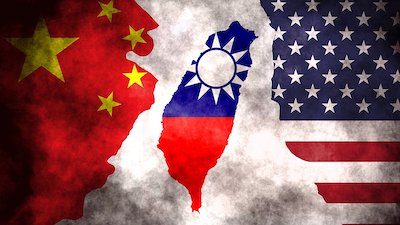
China’s got its eyes locked on Taiwan, and the heat’s turning up fast. With Beijing’s military flexing like a bully in the schoolyard, the U.S. is staring down a high-stakes showdown that could reshape the Indo-Pacific and test the America First resolve. Defense Secretary Pete Hegseth’s blunt warnings about a potential Chinese invasion aren’t just tough talk—they’re a wake-up call about our obligations to Taiwan and what’s at stake if we don’t hold the line. Here’s the unvarnished truth about the brewing storm and why America must be ready to back its promises with steel.
Tensions between China and Taiwan have been simmering for decades, rooted in the Chinese Civil War’s fallout when the Nationalists fled to Taipei in 1949, setting up a government-in-exile while the Communists seized the mainland. Beijing claims Taiwan as its own, vowing “reunification” by force if needed, while Taiwan’s 23 million people cling to their democratic independence. Since 2016, when Taiwan’s Democratic Progressive Party took power under President Lai Ching-te, China’s ramped up the pressure—daily air and naval incursions, massive war games, and a blockade rehearsal in April 2025 that saw Chinese jets and warships swarm the island. Beijing’s People’s Liberation Army is building muscle at breakneck speed, with Xi Jinping ordering it ready for a Taiwan invasion by 2027.
Enter Pete Hegseth, Trump’s no-nonsense Defense Secretary, who’s sounding the alarm louder than a foghorn. At the Shangri-La Dialogue in Singapore on May 31, 2025, Hegseth didn’t mince words: “The threat China poses is real. And it could be imminent.” He called out Beijing for “rehearsing for the real deal,” accusing them of seeking to “dominate and control” Asia while harassing Taiwan and neighbors like the Philippines in the South China Sea. Hegseth’s message was clear: any Chinese move to conquer Taiwan would trigger “devastating consequences for the Indo-Pacific and the world.” He’s not just posturing—his interim National Defense Strategic Guidance names China as the Pentagon’s “sole pacing threat” and stopping a Taiwan takeover as its top priority. The U.S. is war-gaming a full-scale conflict, with Hegseth vowing America will “fight and win” if deterrence fails.
So, what’s America’s obligation if China rolls the dice? The Taiwan Relations Act of 1979 is our bedrock. It commits the U.S. to provide Taiwan with defensive weapons and services to maintain its self-defense capability and to maintain the capacity to resist any force that jeopardizes Taiwan’s security or economy. But here’s the rub: the TRA doesn’t mandate direct military intervention, leaving room for the longstanding policy of “strategic ambiguity.” Trump’s team, however, is shredding that playbook. Hegseth’s explicit pledge to defend Taiwan, backed by Trump’s promise that China won’t take the island “on his watch,” signals a shift to strategic clarity. The U.S. is legally bound to treat threats to Taiwan as a “grave concern” and has 50,000 troops in Japan ready to pivot, alongside upgraded war-fighting headquarters to coordinate with allies like Japan and Australia.
China’s not backing down. They’ve accused Hegseth of “vilifying” them with “defamatory allegations” and warned the U.S. not to “play with fire.” Their embassy in Singapore called his speech “steeped in provocations,” while their foreign ministry blasted America as the “biggest troublemaker” in the region. Beijing’s been flexing with “grey zone” tactics—near-daily incursions and a massive military buildup—while dismissing U.S. tariffs and trade talks as distractions from their Taiwan obsession. Japan, just 70 miles from Taiwan, is so spooked they’re building bomb shelters and planning to evacuate 100,000 civilians in a crisis.
What’s at stake? Everything. Taiwan produces 92% of the world’s advanced logic chips, powering everything from your iPhone to Pentagon missiles. A Chinese takeover would tank the global economy, with the U.S. and China—43% of global GDP—facing massive contractions. A full-scale war would be catastrophic, with Taiwan’s economy in ruins and global trade crippled. The Council on Foreign Relations calls Taiwan the “likeliest flashpoint” in U.S.-China relations, and Hegseth’s war-gaming underscores the Pentagon’s fear that Beijing’s not bluffing.
For the America First crowd, this is about more than geopolitics—it’s about keeping our word. Taiwan’s a democracy standing up to a communist bully, and abandoning them would signal weakness to every adversary from Beijing to Tehran. Hegseth’s pushing allies like Japan and Australia to step up defense spending, insisting they be “partners, not dependents.” He’s got a point: deterrence ain’t cheap, and America can’t carry the load alone. But with China’s navy dwarfing ours and their hypersonic missiles outpacing our defenses, the U.S. needs to bulk up fast—think more ships, more F-35s, and a “Golden Dome” missile shield.
The left will cry that Hegseth’s saber-rattling risks World War III, and sure, nobody wants a shooting match with China. But backing down isn’t an option either. If we let Beijing steamroll Taiwan, what’s next—Japan? The Philippines? Our homeland? The America First ethos means protecting our interests and allies, not cowering to a regime that’s been fleecing us for decades. Hegseth’s war games aren’t reckless—they’re reality. We’ve got to be ready to back our promises with firepower, or we’ll lose more than just an island. Taiwan’s fight is our fight, and it’s time to show China we mean business.